
How do we measure diamond quality? The 4 C'sUpdated 15 days ago
Diamond engagement rings & the diamond qualities used
We use the GIA International Diamond Grading System which is based on the 4 Cs
Carat Weight | Clarity | Colour | Cut
What are the 4 Cs?
The 4 Cs refer to the four diamond quality factors: – Carat weight, Clarity, Colour and Cut.
GIA, or the Gemological Institute of America, is the world’s most trusted authority in diamond and gemstone quality. Their 4 Cs diamond grading system is accepted as a universal standard for measuring diamond quality, and used by virtually all jewellery professionals around the world.
Each factor is evaluated separately, but together they establish a diamond’s overall quality.

CARAT WEIGHT
A “carat” is the measurement of how much a diamond weighs. One carat equals 200 milligrams. One carat can be further divided into 100 points. This means we can weigh diamonds very, very precisely, to one-hundredth decimals.
For example, a diamond that weighs three quarters of a carat can be expressed as 0.75ct, or “point oh seventy-five carats”.
It’s always useful to remember that a diamond’s price is determined by all of the 4Cs, not just its carat weight.
So in other words, if the other three quality factors (clarity, colour and cut) remain the same, then a diamond’s price will increase with carat weight. But if the other quality factors vary, then two diamonds of equal carat weight can have very different prices.
For example, a 1.00 carat diamond with excellent clarity will cost substantially more than a 1.00 carat diamond with poor clarity.
Want to see what different diamond carat weights look like on your hand?
CLICK HERE to see real diamond carat weights and sizes.
CLARITY
Diamonds were formed million of years ago, deep under the earth’s crust and under extreme volcanic pressure. Because of this, they often contain unique marks and small imperfections, called “inclusions”. Diamond “clarity” refers to the absence of inclusions.
In other words, the fewer inclusions, the better the diamond’s clarity.
Every diamond is unique and all diamonds contain some inclusions. Any diamond that comes close to perfection is called flawless, but they are so rare that only a few gem experts or jewellers ever get to see one.
Within the 4 Cs evaluation system, diamonds are given a clarity grade which ranges from flawless (FL), to diamonds with obvious inclusions (I3).

CLARITY GRADES
Diamond engagement rings & the diamond qualities used
We use the GIA International Diamond Grading System which is based on the 4 Cs
Carat Weight | Clarity | Colour | Cut
Read more about the 4Cs below.
What are the 4 Cs?
The 4 Cs refer to the four diamond quality factors: – Carat weight, Clarity, Colour and Cut.
GIA, or the Gemological Institute of America, is the world’s most trusted authority in diamond and gemstone quality. Their 4 Cs diamond grading system is accepted as a universal standard for measuring diamond quality, and used by virtually all jewellery professionals around the world.
Each factor is evaluated separately, but together they establish a diamond’s overall quality.
CARAT WEIGHT
A “carat” is the measurement of how much a diamond weighs. One carat equals 200 milligrams. One carat can be further divided into 100 points. This means we can weigh diamonds very, very precisely, to one-hundredth decimals.
For example, a diamond that weighs three quarters of a carat can be expressed as 0.75ct, or “point oh seventy-five carats”.
It’s always useful to remember that a diamond’s price is determined by all of the 4Cs, not just its carat weight.
So in other words, if the other three quality factors (clarity, colour and cut) remain the same, then a diamond’s price will increase with carat weight. But if the other quality factors vary, then two diamonds of equal carat weight can have very different prices.
For example, a 1.00 carat diamond with excellent clarity will cost substantially more than a 1.00 carat diamond with poor clarity.
Want to see what different diamond carat weights look like on your hand?
CLICK HERE to see real diamond carat weights and sizes.
CLARITY
Diamonds were formed million of years ago, deep under the earth’s crust and under extreme volcanic pressure. Because of this, they often contain unique marks and small imperfections, called “inclusions”. Diamond “clarity” refers to the absence of inclusions.
In other words, the fewer inclusions, the better the diamond’s clarity.
Every diamond is unique and all diamonds contain some inclusions. Any diamond that comes close to perfection is called flawless, but they are so rare that only a few gem experts or jewellers ever get to see one.
Within the 4 Cs evaluation system, diamonds are given a clarity grade which ranges from flawless (FL), to diamonds with obvious inclusions (I3).

CLARITY GRADES
COLOUR
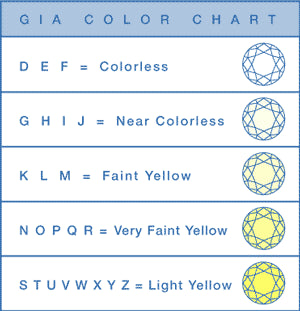
Assessing diamond “colour” refers to the absence of any kind of colour tint or hue in the diamond.
In other words, the more colourless a diamond is, the better its colour grade.
The GIA’s diamond colour grading system measures the degree of colourlessness in diamonds on a scale from D (best, or colourless) to Z (worst, with a clearly visible colour tint).
Many of these colour differences are so subtle that they are only visible to diamond experts under laboratory conditions. The smaller the diamond, the more difficult it is to spot these differences.
That’s why it’s important to not get too fixated on a certain diamond grade. A good jeweller will always guide you to the best colour grade for your budget.
CUT
Most people who love diamonds say that they’re attracted to the stone’s beautiful “sparkle”. This is of course due to how diamonds reflect and “play” with light.
How well a diamond interacts with light is largely determined by its cut. Therefore, the cut affects a diamond’s beauty, as well as its value.
The quality of a diamond’s cut depends on the skilled craftsmanship and experience of the person who carved and polished it from a rough stone.
Of all the 4Cs, the cut is the most complex factor for a diamond expert to evaluate.
When measuring a diamond’s cut grade, gemmologists assess the external and internal light reflection (brightness), the way the stone scatters white light into all colours of the rainbow (fire) and the sparkle and patterns of light and dark caused by reflections within the diamond (scintillation).
Finally, a diamond’s overall appearance, as well as its durability, design, polish and symmetry, must be taken into consideration.
Note – a diamond’s “cut” does not refer to its shape (round, princess, emerald, pear), but how successfully it plays with light.
COLOUR
Assessing diamond “colour” refers to the absence of any kind of colour tint or hue in the diamond.
In other words, the more colourless a diamond is, the better its colour grade.
The GIA’s diamond colour grading system measures the degree of colourlessness in diamonds on a scale from D (best, or colourless) to Z (worst, with a clearly visible colour tint).
Many of these colour differences are so subtle that they are only visible to diamond experts under laboratory conditions. The smaller the diamond, the more difficult it is to spot these differences.
That’s why it’s important to not get too fixated on a certain diamond grade. A good jeweller will always guide you to the best colour grade for your budget.
CUT
Most people who love diamonds say that they’re attracted to the stone’s beautiful “sparkle”. This is of course due to how diamonds reflect and “play” with light.
How well a diamond interacts with light is largely determined by its cut. Therefore, the cut affects a diamond’s beauty, as well as its value.
The quality of a diamond’s cut depends on the skilled craftsmanship and experience of the person who carved and polished it from a rough stone.
Of all the 4Cs, the cut is the most complex factor for a diamond expert to evaluate.
When measuring a diamond’s cut grade, gemmologists assess the external and internal light reflection (brightness), the way the stone scatters white light into all colours of the rainbow (fire) and the sparkle and patterns of light and dark caused by reflections within the diamond (scintillation).
Finally, a diamond’s overall appearance, as well as its durability, design, polish and symmetry, must be taken into consideration.
Note – a diamond’s “cut” does not refer to its shape (round, princess, emerald, pear), but how successfully it plays with light.